ASTM A370 – Pruebas Mecánicas y Normativas: Análisis, Aplicación y Mejores Prácticas en la Industria
ASTM A370 – Quiz 3
3. Terminology
3.1 Definitions:
3.1.1 For definitions of terms pertaining to mechanical testing of steel products not otherwise listed in this section, reference shall be made to Terminology E6 and Terminology A941.
3.2 Definitions of Terms Specific to This Standard:
3.2.1 fixed-location hardness testing machine, n—
a hardness testing machine that is designed for routine operation in a fixed-location by the users and is not designed to be transported, or carried, or moved.
3.2.1.1 Discussion—
Typically due to its heavy weight and large size, a fixed-location hardness testing machine is placed in one location and not routinely moved.
3.2.2 longitudinal test, n—
unless specifically defined otherwise, signifies that the lengthwise axis of the specimen is parallel to the direction of the greatest extension of the steel during rolling or forging.
3.2.2.1 Discussion—
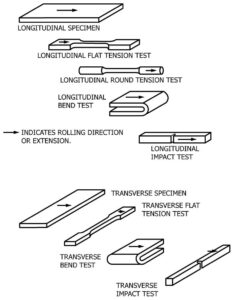
The stress applied to a longitudinal tension test specimen is in the direction of the greatest extension, and the axis of the fold of a longitudinal bend test specimen is at right angles to the direction of greatest extension (see Fig. 1, Fig. 2a, and Fig. 2b).
3.2.3 portable hardness testing machine, n—
a hardness testing machine that is designed to be transported, carried, set up, and that measures hardness in accordance with the test methods in Section 19.
3.2.4 radial test, n—
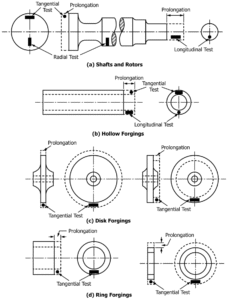
unless specifically defined otherwise, signifies that the lengthwise axis of the specimen is perpendicular to the axis of the product and coincident with one of the radii of a circle drawn with a point on the axis of the product as a center (see Fig. 2a).
3.2.5 tangential test, n—
unless specifically defined otherwise, signifies that the lengthwise axis of the specimen perpendicular to a plane containing the axis of the product and tangent to a circle drawn with a point on the axis of the product as a center (see Fig. 2a, Fig. 2b, Fig. 2c, and Fig. 2d).
3.2.6 transition temperature, n—
for specification purposes, the transition temperature is the temperature at which the designated material test value equals or exceeds a specified minimum test value.
3.2.6.1 Discussion—
Some of the many definitions of transition temperature currently being used are:
- the lowest temperature at which the specimen exhibits 100 % fibrous fracture,
- the temperature where the fracture shows a 50 % crystalline and a 50 % fibrous appearance,
- the temperature corresponding to the energy value 50 % of the difference between values obtained at 100 % and 0 % fibrous fracture, and
- the temperature corresponding to a specific energy value.
3.2.7 transverse test, n—
unless specifically defined otherwise, signifies that the lengthwise axis of the specimen is right angles to the direction of the greatest extension of the steel during rolling or forging.
3.2.7.1 Discussion—
The stress applied to a transverse tension test specimen is at right angles to the greatest extension, and the axis of the fold of a transverse bend test specimen is parallel to the greatest extension (see Fig. 1).
3.3 Definition of Terms Specific to the Procedure for Use and Control of Heat-cycle Simulation (See Annex A9):
3.3.1 master chart, n—
a record of the heat treatment received from a forging essentially identical to the production forgings that it will represent.
3.3.1.1 Discussion—
It is a chart of time and temperature showing the output from thermocouples imbedded in the forging at the designated test immersion and test location or locations.
3.3.2 program chart, n—
the metallized sheet used to program the simulator unit.
3.3.2.1 Discussion—
Time-temperature data from the master chart are manually transferred to the program chart.
3.3.3 simulator chart, n—
a record of the heat treatment that a test specimen had received in the simulator unit.
3.3.3.1 Discussion—
It is a chart of time and temperature and can be compared directly to the master chart for accuracy of duplication.
3.3.4 simulator cycle, n—
one continuous heat treatment of a set of specimens in the simulator unit.
3.3.4.1 Discussion—
The cycle includes heating from ambient, holding at temperature, and cooling. For example, a simulated austenitize and quench of a set of specimens would be one cycle; a simulated temper of the same specimens would be another cycle.